

NORTH BRITISH
Full length video
Please read Understanding catalogue records for help interpreting this information and Using footage for more information about accessing this film.
Title: NORTH BRITISH
Reference number: 1276
Date: 1949c
Director: d. John S. Abbott, Jnr.
Sponsor: North British Locomotive Company
Production company: The Big Six Film Unit
Sound: sound
Original format: 16mm
Colour: bw
Fiction: non-fiction
Running time: 39.54 mins
Description:
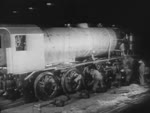
Promotional film for North British Locomotive Company, Glasgow with coverage on how the locomotive "Bartholomew Diaz" was manufactured and sent to South Africa.
The "Bartholomew Diaz" was the 2000th locomotive sent to South Africa and was named after a Portugese explorer and unveiled by the 50th African Minister of Transport. Locomotive handed over by Sir Andrew Duncan, director of the North British Locomotive Company in the presence of Mr Lorimer (co. dir.) and the Portugese ambassador.
Credits:
ph. Alfred Kerntiff
sd. C. W. Green
m. De Wolfe
technical d. C. W. Hancock
p. Edward Cook
Shotlist: Credits (.52); Steam locomotive driving along tracks. (1.02); Pan from Queen Street station to City Chambers (1.10); General shots of Glasgow, including the Albert Bridge, Provand's Lordship, Glasgow Cathedral, the Royal Infirmary and Glasgow Cross. (1.52); Unidentified railway platform (2.08); Exterior shot of the North British Locomotive Company works at Springburn in Glasgow (2.22); Tracking shot of shop floor at locomotive works (2.59); Exterior shot of the North British locomotive works and rooftop shots of the workshops (3.27); Shot of the exterior of the North British offices (3.47); Interior shot of the drawing offices at North British and close-ups of the draughtsmen at work (5.01); Tracking shot of the shop floor and close-ups of the men working at a lathe, also close-ups of lathe itself (6.44); General shots of men working on the wheels and tracking shot of shop floor. Close-ups of men working on machines and benches (7.49); General shots of shop floor (9.00); Close-ups of men checking sites (9.52); General shots of shop floor and close-ups of men assembling a cast (10.50); The molten steel enters the cast (11.24); Tracking shot of the shop floor and close-ups of engineers and turners at work (15.52); Close-ups of men working at the forge and press (16.59); Shots of men at work on the piston rods and other parts, with shots of turners at work. Also shots of men finishing parts (25.13); General shots in the drawing office (24.03); Woman punching identification plates and shots of typists at work (25.01); General shots of shop floor and shots of press in action (26.50); Men working on boiler and other body parts, also shot of crane lifting boiler into position, where men assemble the engines (29.54); Testing engines (30.37); Making identification plates (31.04); Unveiling of plaque on the 2000th North British locomotive sent to South Africa, "Barthomew Diaz" (31.32); Train and carriages passing through South African countryside (31.47); Close-ups of North British loco. no. 60203 being testing outside workshops (33.20); Simmer and Jack Mines Ltd No 6 loco. being tested, also shots as it is packed into wooden cases. Crane lifts part of engine (34.41); Tracking shot of shop floor and general shots men at work and fixing ID plate to engine (36.40); Lorries tow engine from Queen's Park works and pass over Jamaica bridge before loading onto "Glen Campbell", ship berthed at Yorkhill Quay. Good shots as crane lifts engine onto ship (39.18); Shots of the ship being towed out by tugs (40.54).